
See the opportunity before the team starts creating.
The Research Agent analyzes keyword demand, competitor coverage, SERP positioning, trend data, and search intent — delivering a scored signal board so the team knows where real opportunities are.
This replaces hours of SEO tool exports and spreadsheet prioritization. The Research Agent hands its findings directly to the Strategy Agent.
Turn scattered signals into a structured content roadmap.
The Strategy Agent clusters related opportunities into topic groups, maps them to page types and funnel roles, and produces prioritized execution plans with search promise, differentiation, and CTA strategy.
This is where strategy becomes a real plan — what to create, what to optimize, what to skip. The Strategy Agent's output becomes the handoff to the Writer Agent.
Create an execution plan that gives production a point of view.
Convert page plans into execution plans with search promise, keyword direction, differentiation, internal linking guidance, CTA strategy, and success criteria.
That plan becomes the contract between planning and creation — so the Writer Agent enters production with real direction instead of vague requirements.
Make every page the answer AI engines cite.
The GEO Agent turns each plan into an answer strategy: the questions people ask ChatGPT, Perplexity, and AI Overviews, the direct answer the page must open with, citation-worthy facts, entities to cover, and the structured data the page must ship with.
This runs before writing — so AI-answer optimization is built into the draft, not retrofitted at publish. The Writer Agent receives the answer contract with the brief, and the quality gate enforces it before anything ships.
Build the source asset with real control.
The Writer Agent generates the flagship page or campaign anchor as structured, editable content blocks — with web research, image generation, and section-level regeneration.
The team shapes the source asset block by block instead of accepting a single draft. Once approved, the Writer Agent hands off to the Editor Agent.
Review before the team turns one asset into many.
The Editor Agent runs three specialist passes — Critic (structure, flow, clarity), Validation (completeness, consistency), and Persona (buyer/operator fit) — producing structured issues with precise locations and bounded fix plans.
The goal is not just more content. The goal is stronger source content that is actually worth scaling. After fixes, the Editor Agent revalidates before handing off to the Campaign Agent.
Plan the rollout before anything gets shipped.
The Campaign Agent takes the approved source and places outputs on the campaign calendar — sequencing work by day and channel so the team sees timing before execution starts.
This keeps cadence, dependencies, and channel pacing visible instead of scattering rollout decisions across spreadsheets and planning docs.
Publish without breaking the workflow.
The Publisher Agent pushes approved assets through connected CMS platforms and social channels — WordPress, Webflow, LinkedIn, X, Meta — so the path from source content to live execution stays inside one system.
Fewer handoffs, less tab-switching, and a clearer line from approved source to shipped campaign.
One approved source becomes 30+ channel-ready assets.
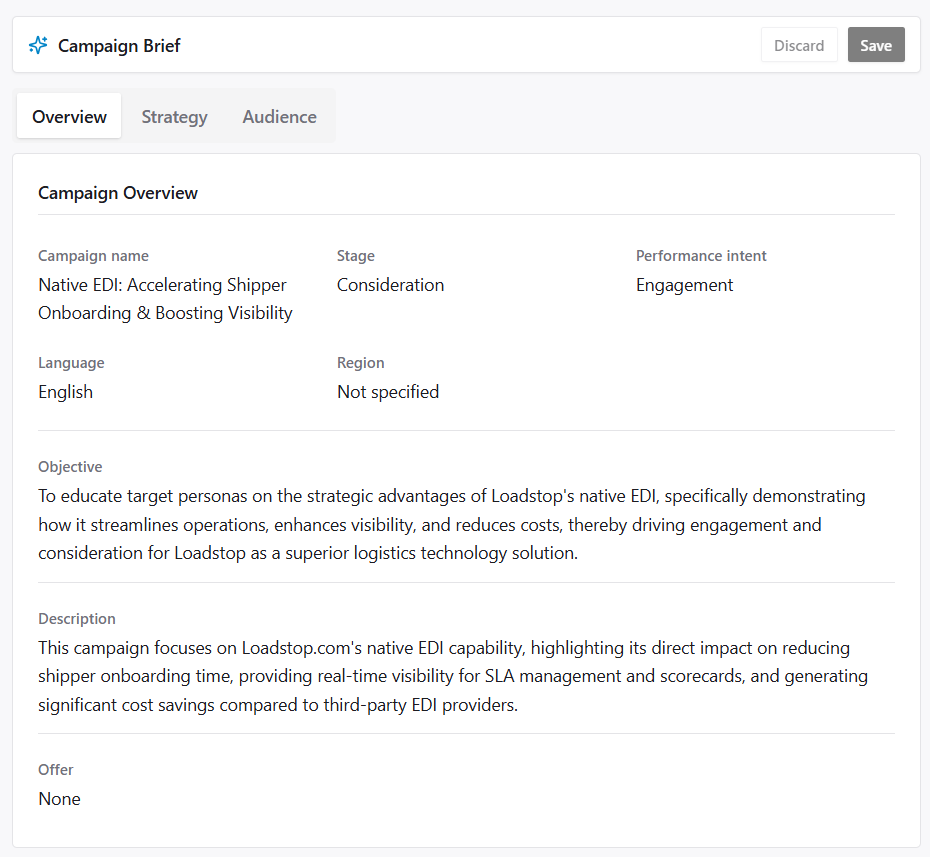
The Campaign Agent turns strong approved source content into downstream campaign assets — blog support, email sequences, social threads, landing CTAs, and more — all aligned with the original strategy.
One source becomes a coordinated campaign system instead of a one-off asset. Preview, regenerate, and control which derivatives ship.
Not one AI doing everything. A team of specialists with structured handoffs.
See the full agent pipeline from signal to shipped campaign.
Book a demo to see how eight specialized agents — Research, Strategy, GEO, Writer, Editor, Design, Campaign, and Publisher — work in sequence to run your campaign pipeline.